

Turnkey vs. best-of-breed in technical textiles:
which production line strategy fits your process?

You are facing a critical investment in the finishing phase of your technical textile production process, whether you produce geotextiles, filter media, nonwovens, agrotextiles or industrial fabrics. The manufacturing requirements for technical textiles are becoming increasingly strict. Variable grammages, sensitive coatings, and high processing speeds leave absolutely no room for error.
When designing a new post-production line, you inevitably encounter a fundamental strategic choice. Do you opt for a ‘best-of-breed’ approach where you combine the best individual machines yourself? Or do you choose a ‘turnkey’ solution where a single integrator delivers the entire line from start to finish?
In reality, the answer is rarely that simple. Technical textiles are becoming increasingly demanding to process. Variable grammages, sensitive coatings and high production speeds leave little room for error. But the real challenge is not just in the machines themselves — it lies in how they interact as a complete system.
The right choice is therefore not about the concept alone, but about how well it fits your production reality.
This depends heavily on your internal engineering capacity, your risk tolerance, and the physical complexity of the material you need to process. We analyze both approaches in detail — looking specifically at their impact on system integration, risk management, and the long-term scalability of your machinery.
What is a best-of-breed strategy?
In a best-of-breed approach, you select the absolute best machine on the market for each specific process step. For example, you might purchase an unwinder from Supplier A, a highly specialized slitting module from Supplier B, and a rewinder from Supplier C. Your internal project team or an external engineering partner then connects these individual components to form a complete production line.
The advantages of best-of-breed
The primary advantage of this approach is the theoretical optimization of each individual process step. You choose the exact technology that perfectly aligns with a specific mechanical operation. For a complex lamination step, you might find a niche player who masters that one detail significantly better than a generalist manufacturer. You are never bound to the standard product range of a single machine builder.
Additionally, this approach gives you complete control over the technical specifications of each separate module. This is highly attractive for companies with a large, highly experienced internal engineering team that prefers to keep a tight grip on system architecture.

“A fraction of a second of delay in communication between two modules directly leads to the narrowing or stretching of the material — and that means expensive scrap.”
The pitfalls of best-of-breed
The challenges of the best-of-breed strategy invariably lie in the transitions between the different machines. Technical textiles are extremely sensitive to variations in web tension. When an unwinder from Brand A needs to communicate with a slitting module from Brand B, a blind spot in tension control often emerges.
Furthermore, as the buyer, you bear the full integration risk. If the line fails to achieve the desired output, suppliers often point fingers at each other. Resolving software conflicts and integrating safety protocols (such as an overarching emergency stop system) costs significant time and money.
Why manufacturers choose turnkey solutions
A turnkey solution means that one partner takes responsibility for the performance of the complete production process — from pre-processing to post-production. In some cases, this includes fully built and delivered systems. In others, it involves integrating existing and new technologies into one coherent production line.
The key is not only who supplies the machines, but how the entire line is designed to function as one system. Because one party defines the overall architecture, web tension can be managed consistently across the full line. All modules operate within a coordinated control environment. If one process step slows down, the others adjust in real time. This prevents creases, folds and material damage, while ensuring stable production at higher speeds.
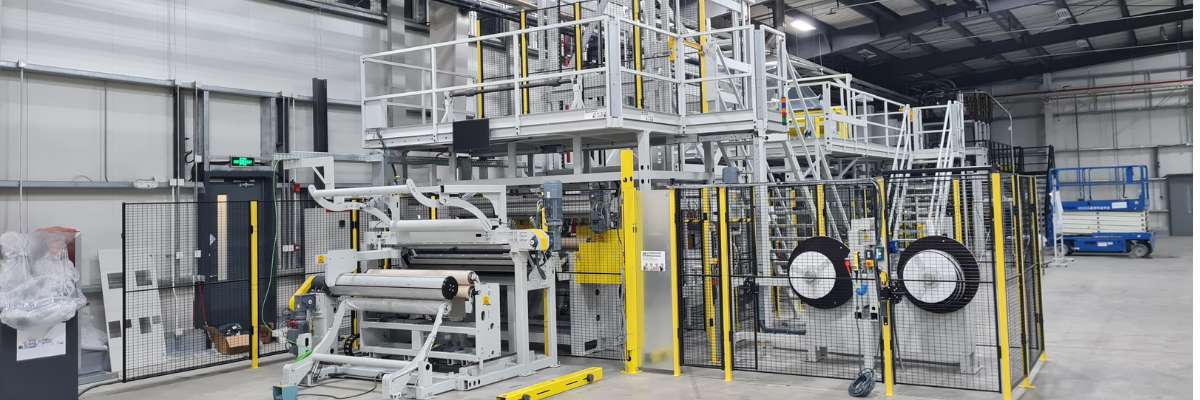
This is where the role of an integrator becomes critical. One integrator aligns the complete production line — ensuring all modules, whether newly built or already in place, work together as one stable system,as demonstrated in our recent integrated line project with ↗ Condako Engineering .
The real question: which kind of integrator?
A common concern about turnkey solutions is ‘vendor lock-in’. Manufacturers worry about being stuck with the integrator’s standard modules, even if those are not the best fit for a specific process step. That concern is legitimate because not every integrator works the same way. This is where experience in complex production environments becomes critical.
The critical distinction is between integrators who operate within a fixed partner ecosystem and those who design independently. An independent integrator can incorporate external specialist modules (such as corona treatment, perforation, and others) from any partner that best fits your material and process requirements. The architecture is built around your process, not around the integrator’s preferred supplier list. This approach combines the process security of turnkey with the technical precision of best-of-breed, without forcing you to compromise on either.
How this impacts critical production steps
To fully understand the impact of both choices, we must examine three crucial steps in the finishing phase.
01 — Stable web tension & tension control
For technically demanding materials — from lightweight filter media to heavy geotextiles — constant web tension is vital. In a best-of-breed setup, different drives must synchronize perfectly, requiring highly complex master-slave configurations between machines from different brands. In a turnkey solution, the tension control system is designed from the ground up as a single holistic system, guaranteeing smooth material flow even during emergency stops or rapid changeovers, and across the full range of material variants on the same line.
02 — Precision cutting & slitting
The choice between techniques like shear cut and crush cut is not simply a matter of reading a specification sheet — it depends on how your specific material behaves under process conditions. In a best-of-breed setup, you can select a cutting specialist with deep expertise in exactly your material type, which can be a real advantage for niche applications. On the other hand, a turnkey integrator designs the web guiding and the cutting zone as one block, ensuring that the cutting quality remains consistent.
03 — Reliable roll build & rewinding
A perfectly cut web has zero value if the roll build fails. Rewinding requires exact control over the winding tension with the right speed. A roll wound too loosely becomes oval during transport; wound too tight, and you damage the internal fabric structure. Rewinding is the final piece of the puzzle — any mistakes made earlier in the line manifest here. An integrated line absorbs small variations at the front of the process, ensuring the rewinder consistently delivers a stable, saleable roll.
Scalability and future-proofing
Your production environment will inevitably evolve. Perhaps next year you will want to add a vision inspection system or transition from rolling to automated folding to save on logistics.
A best-of-breed line can offer real flexibility when individual modules need to be replaced or upgraded, since you are not dependent on a single party for every change. The challenge lies in software and protocol compatibility between suppliers, which can make broader modifications more complex.
A modular turnkey line can simplify scalability — the integrator knows the source code and the mechanical limits of the system — but this advantage only holds if the line was designed with future flexibility in mind from the start.

Beyond technology: how your organisation shapes the choice
In practice, the choice between turnkey and best-of-breed is not only technical. It is also influenced by how a company is structured. Some manufacturers operate with centralized project teams and predefined supplier ecosystems. In these environments, process steps are often sourced separately and integrated internally. Others — particularly converters or companies working with a wide variety of materials — require more flexibility and prefer a single partner who can integrate the full line.
We see both worlds.
From large-scale producers working with established machine suppliers to converters and technical textile specialists who need adaptable, modular solutions. In some cases, we are involved in a specific part of the process. In others, we take responsibility for the complete line.
Conclusion: how do you make the right choice?
The choice between turnkey and best-of-breed is not about choosing a label. It is about understanding your process, your material behaviour, and your internal capabilities. In practice, we see that different types of customers require different approaches. Some prefer a fully integrated solution with one point of responsibility, while others — supported by strong internal engineering teams — opt for a more distributed setup. The right choice is therefore defined by how well the solution fits your production reality: your ability to manage integration, the importance of stable web tension and speed, and the level of responsibility you expect from your partners.
For producers of technical textiles — whether geotextiles, nonwovens, filter media, agrotextiles or industrial fabrics — the impact of errors is significant. Materials are expensive, and the quality demands are high. What matters most is not which label you choose, but whether the entire production line performs as one stable system. Mapping your operational bottlenecks and evaluating your internal engineering capacity will help clarify the right direction — independent of the strategy label.
Handsaeme Machinery supports customers in aligning their production lines — whether through fully integrated solutions or modular setups.
Want to evaluate your production setup? Feel free to contact our expert Jonas for a no-obligation discussion. Or meet us at Techtextil 2026 to explore your challenges in person.
Want to evaluate your production setup?
Discuss your production challenges with our expert Jonas.Other news
We engineered a specialized revert-roll solution to enhance Tarkett’s turf backcoating line. Read Tarkett’s full experience here.


