Carpet & textile

Post-production automation in technical textiles

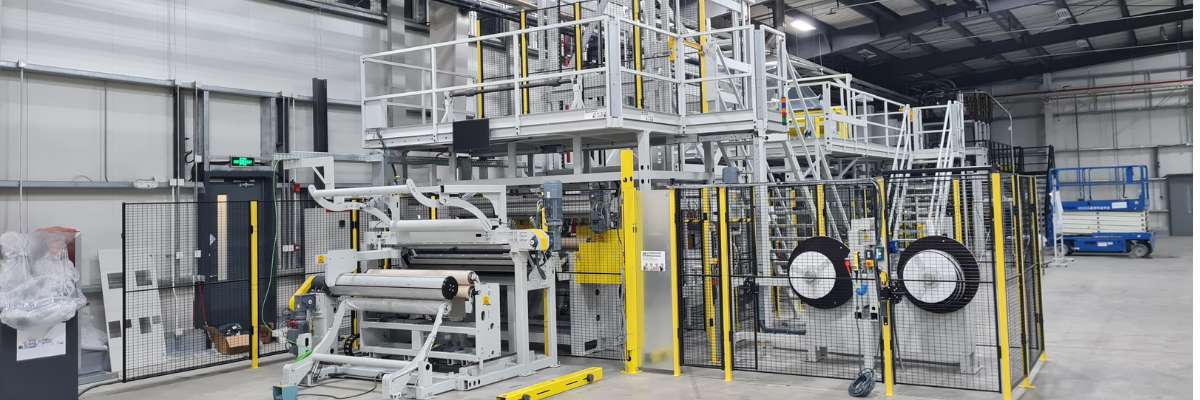
Unwinder for fibre optic material made by Handsaeme Machinery, an important step for post-production automasation

Handsaeme’s experience in technical textiles: mastering post-production automation


The production of technical textiles is a complex process where quality and efficiency must go hand in hand. While primary production (such as weaving, coating, or laminating) lays the foundation, the finishing phase often determines the final product quality. When master rolls are converted into customer-ready products, even minor deviations in tension, cutting quality, or roll build-up can lead to scrap, rejection, and thus margin loss.


“With decades of experience in post-production automation, we provide solutions that combine speed, precision, and quality.”


At Handsaeme Machinery, we understand these challenges like no other. Our focus lies on controlled tension, stable and precise shear cutting technology, and reliable roll formation. Whether it’s tension control for nonwovens, shear cutting for sensitive materials, or the turnkey integration of complete lines, we ensure your production process runs smoothly and without any loss of quality.


Leveraging our expertise in technical textiles and post-production automation, we help manufacturing companies increase their output, reduce waste, and protect their margins. Discover how we can be your partner in achieving a more efficient and reliable production process.

The challenge in technical textiles


Technical textiles is a collective term for materials designed to fulfill a technical function rather than a decorative or fashion-related one. It covers a wide range of materials, including nonwovens, membranes, films, composites, and multilayered structures. Companies use these materials in sectors such as industry, infrastructure, filtration, and agriculture.


What makes technical textiles unique is the combination of robustness and sensitivity. Many products have coatings or laminates and can vary significantly in thickness, friction, and elasticity. Production rolls are often large and heavy, which places additional demands on safety and ergonomics during the finishing phase.


Typical production challenges in technical textiles are not limited to, but include:

  • Variable grammages: Within a single product portfolio, the weight of materials can differ by a factor of 100.
  • Sensitive coatings: Damage during handling can directly lead to a loss of quality.
  • Complex structures: Multilayered materials require precision in tension and cutting technology

The crucial role of post-production


Typical post-production activities in the finishing of technical textiles include:

  • Unwinding: tensionless unwinding to prevent stretching or deformation.
  • Slitting/Cutting: precision cutting to prevent fraying and material waste.
  • Rewinding: stable roll build-up to avoid transport issues and keep the textiles in shape.
  • Inspection: vision systems to detect defects in an early stage and certainly before products go to the customer.
  • Packaging: automated and consistent packaging for transport-ready output.


Post-production crosscutting machine by Handsaeme machinery, an important step in automasation

Although primary production lays the groundwork, the finishing phase often determines the final product quality, where master rolls are converted into customer-ready products. Small deviations in tension, cutting quality, or roll formation can result in scrap, rejection, and margin loss. This makes post-production a strategic lever for quality, efficiency, and margin preservation.


It’s clear then that the most critical tasks in the finishing stage are therefore:

  • Keep the tension correct: incorrect tension can lead to material narrowing or stretching.
  • Cut quality: errors in cutting cause scrap and quality degradation.
  • Roll build-up: Oval or crooked rolls complicate transport and further processing.

Common challenges in technical textiles


The industry is very competitive, and this leads to very demanding claims in the production process. Most production facilities face:

  • A great variation in fabricated material where there are significant differences in grammage and structure of the several materials produced. This leads to a demanding flexibility in the finishing line.
  • Fabrication at higher speeds: as production speeds increase, error tolerance decreases and the tolerance margins become smaller. A high-speed nonwoven finishing line is a must.
  • A flexible attitude towards the customer: as a greater variation in widths, lengths, and packaging requirements are demanded by customers, the process must become very stable and controlled.


In each step of the process, several critical factors must be considered to develop a finishing solution that meets your demands:

  • Unwinding: wrinkle-free and fold-free unwinding, with the possibility of buffering to accommodate stops.
  • Slitting/Cutting: precision cutting to avoid imperfections, wear and tear on cutting tools, material waste.
  • Rewinding: stable roll formation must be guaranteed to prevent ovality and edge problems. This means the tension must be maintained continuously.
  • Control: visual control and process feedback to detect errors in an early stage.
  • Packaging: managing variable product flows demands consistent packaging.

Our solutions


Our core competence is to develop integrated and high-speed finishing lines with following characteristics:

  • Advanced tension control: For consistent tension across the entire line.
  • Custom-engineered lines: Tailor-made solutions for complex materials and technical non-wovens.
  • Integration of external modules such as lamination, corona treatment, and vision systems.
  • Turnkey projects: We are your single partner for engineering, integration, and start-up.

↗ (also read our blog: Best-of-breed vs Turnkey solutions: what is the best choice?) 

This solution map summarizes how we approach the problems our customers may face:

Customer problem Handsaeme Machinery approach
Wrinkles, folds, edge damage Engineered web guiding and tension control
Fraying / poor cut quality Correct cutting technology and stable guidance
Unstable roll build-up Control over winding parameters
Manual bottlenecks Automation of repetitive tasks


We also develop solutions for converting and folding

  • Converting: high-speed and consistent quality in cut-to-order automation.
  • Folding: We develop new logistical possibilities to end-customers by offering folded products instead of rolls.

So why choose Handsaeme Machinery?


We have decades of experience in this industry, and have developed a very specific skillset that meets the requirements you have for a perfect finishing touch:

  • Strong in customization: We develop solutions for non-standard challenges.
  • Open in co-creation: We believe that the best solution is developed in collaboration with the customer.
  • We are an integrator: We are flexible in partnering with various suppliers without vendor lock-in. We use what’s already there – if possible. (also read our testimonial about Condako Engineering ↗ )
  • A determined focus on quality. We work to achieve the results you need: less scrap, more control, higher speed.


We believe that, unlike competitors who are tied to fixed partner ecosystems, our independence and flexibility are a strong competitive advantage, because it enhances design freedom and guarantees the best possible solution for every customer.


If facing similar challenges, we’re happy to exchange thoughts on your post‑production setup.

A deeper look

into post‑production stability
in technical textiles
.
Carpet & textile

Flexible production line for technical textiles: Condako Engineering case

A strong partnership driving innovation

Condako Engineering↗, a specialized supplier to the automotive industry, focuses on developing and producing specialized foils and membranes (non-wovens), customized for specific client applications. This emphasis on custom work requires a production environment that can smoothly switch between various materials and processes. However, their existing production line no longer met these demands sufficiently enough.


“Over the years, we had invested in several stand-alone production machines, each performing their task. We recently also invested in a hot melt coating machine. So, we started thinking of integrating these machines in a flexible full process line. Furthermore, our laminating line was no longer suitable for the broad spectrum of materials we want to process today,” says Michael Boeren, product and process manager of Condako Engineering. “It was far too slow, offered no adequate tension control, and had poor cutting quality. Moreover, we couldn’t perform certain processes independently. If we wanted to slit, we couldn’t laminate.”


To resolve these bottlenecks and increase production capacity, Condako invested in two projects. The first was a new, modular rewinding line where an existing perforating machine and laminating machine were integrated in a flexible finishing line, and a flying cross cutter to place after the lamination machine. Both projects were developed together with Handsaeme Machinery. These investments proved to be a crucial step forward to increase capacity and flexibility.


“It was important to us that the machine was completely tailored to our way of working. Thanks to the close collaboration with Handsaeme, we now have a line that does exactly that.” — Michael Boeren, Product & Process Manager, Condako Engineering

Speed, precision, and modularity

The new Flexline from Handsaeme Machinery combines unwinding, slitting, and rewinding. Its true strength lies in its modular design, which enables the integration of the existing machines which allow perforation, corona treating (the static charging of surface material) and lamination in various sequences.

“The speed of unwinding and rewinding is crucial. Where our old line maxed out at 25 meters per minute, the new line reaches up to 100 meters per minute. With this line, we can combine different processes into a single production flow and still remain extremely flexible. Sometimes all the integrated machines are used, sometimes none, and the order in which they operate can be easily adapted to the product requirements.” — Michael Boeren

Flexible-production-line-for-technical-textiles


One of the biggest technical challenges was the enormous variety of materials. “Between the lightest and heaviest material, there is a huge multiple in grammage,” says Boeren. “Foils can start from 20-micron thickness, and membranes can add up to 200 grams, even higher if needle-punched. If you apply too much tension to a light product, it will stretch or neck down. Perfect tension control is therefore essential and different for each product. The new production line handles this flawlessly.”


An innovative solution was also chosen for cutting: a combination of shear cut and fixed blades, allowing the customer to choose the best cutting method for each material.

In addition to the rewinding line, Condako also implemented a flying cross cutter from Handsaeme behind a standard Reliance double belt laminator. Previously this was only used for flexible materials in a roll to roll process, now we also process rigid composite sheet materials on it (a new product offering by Condako). This machine cuts the continuous laminated composite panels on-the-fly, without needing to slow down or stop the production line. A unique thickness detection system recognizes the transition between the core sheets of the laminated materials, ensuring an extremely precise cut and optimizing material waste.


From supplier to development partner

The collaboration with Handsaeme was exceptionally smooth. “We’ve had very good contact with Jonas, who was our SPOC in the development phase and is not only a commercial representative, but also has a great technical background. But another big advantage was having direct contact with the programmers after the installation,” says Boeren. “During the start-up phase, parameters of the PLC could be adjusted quickly without needing intermediate steps or going too much back and forth. That sped up the implementation enormously.”


Thanks to these new investments, Condako now has a faster, more flexible, and more precise production environment, perfectly suitable for developing new products together with its clients.


Because in the end, it’s not just about the material — it’s about controlling the process around it.

Looking to improve your production flexibility?

Every production line is different — let’s explore what’s possible for your specific application. Discuss your production challenges with Jonas
Carpet & textile

Turnkey vs. best-of-breed in technical textiles:
which production line strategy fits your process?

You are facing a critical investment in the finishing phase of your technical textile production process, whether you produce geotextiles, filter media, nonwovens, agrotextiles or industrial fabrics. The manufacturing requirements for technical textiles are becoming increasingly strict. Variable grammages, sensitive coatings, and high processing speeds leave absolutely no room for error.


When designing a new post-production line, you inevitably encounter a fundamental strategic choice. Do you opt for a ‘best-of-breed’ approach where you combine the best individual machines yourself? Or do you choose a ‘turnkey’ solution where a single integrator delivers the entire line from start to finish?


In reality, the answer is rarely that simple. Technical textiles are becoming increasingly demanding to process. Variable grammages, sensitive coatings and high production speeds leave little room for error. But the real challenge is not just in the machines themselves — it lies in how they interact as a complete system.

The right choice is therefore not about the concept alone, but about how well it fits your production reality.

This depends heavily on your internal engineering capacity, your risk tolerance, and the physical complexity of the material you need to process. We analyze both approaches in detail — looking specifically at their impact on system integration, risk management, and the long-term scalability of your machinery.


What is a best-of-breed strategy?

In a best-of-breed approach, you select the absolute best machine on the market for each specific process step. For example, you might purchase an unwinder from Supplier A, a highly specialized slitting module from Supplier B, and a rewinder from Supplier C. Your internal project team or an external engineering partner then connects these individual components to form a complete production line.


The advantages of best-of-breed

The primary advantage of this approach is the theoretical optimization of each individual process step. You choose the exact technology that perfectly aligns with a specific mechanical operation. For a complex lamination step, you might find a niche player who masters that one detail significantly better than a generalist manufacturer. You are never bound to the standard product range of a single machine builder.


Additionally, this approach gives you complete control over the technical specifications of each separate module. This is highly attractive for companies with a large, highly experienced internal engineering team that prefers to keep a tight grip on system architecture.


winding machine for fibreglass cloth

“A fraction of a second of delay in communication between two modules directly leads to the narrowing or stretching of the material — and that means expensive scrap.”

The pitfalls of best-of-breed

The challenges of the best-of-breed strategy invariably lie in the transitions between the different machines. Technical textiles are extremely sensitive to variations in web tension. When an unwinder from Brand A needs to communicate with a slitting module from Brand B, a blind spot in tension control often emerges.


Furthermore, as the buyer, you bear the full integration risk. If the line fails to achieve the desired output, suppliers often point fingers at each other. Resolving software conflicts and integrating safety protocols (such as an overarching emergency stop system) costs significant time and money.

Why manufacturers choose turnkey solutions

A turnkey solution means that one partner takes responsibility for the performance of the complete production process — from pre-processing to post-production. In some cases, this includes fully built and delivered systems. In others, it involves integrating existing and new technologies into one coherent production line.

The key is not only who supplies the machines, but how the entire line is designed to function as one system. Because one party defines the overall architecture, web tension can be managed consistently across the full line. All modules operate within a coordinated control environment. If one process step slows down, the others adjust in real time. This prevents creases, folds and material damage, while ensuring stable production at higher speeds.

This is where the role of an integrator becomes critical. One integrator aligns the complete production line — ensuring all modules, whether newly built or already in place, work together as one stable system,as demonstrated in our recent integrated line project with ↗ Condako Engineering .


The real question: which kind of integrator?

A common concern about turnkey solutions is ‘vendor lock-in’. Manufacturers worry about being stuck with the integrator’s standard modules, even if those are not the best fit for a specific process step. That concern is legitimate because not every integrator works the same way. This is where experience in complex production environments becomes critical.


The critical distinction is between integrators who operate within a fixed partner ecosystem and those who design independently. An independent integrator can incorporate external specialist modules (such as corona treatment, perforation, and others) from any partner that best fits your material and process requirements. The architecture is built around your process, not around the integrator’s preferred supplier list. This approach combines the process security of turnkey with the technical precision of best-of-breed, without forcing you to compromise on either.

How this impacts critical production steps

To fully understand the impact of both choices, we must examine three crucial steps in the finishing phase.

01 — Stable web tension & tension control

For technically demanding materials — from lightweight filter media to heavy geotextiles — constant web tension is vital. In a best-of-breed setup, different drives must synchronize perfectly, requiring highly complex master-slave configurations between machines from different brands. In a turnkey solution, the tension control system is designed from the ground up as a single holistic system, guaranteeing smooth material flow even during emergency stops or rapid changeovers, and across the full range of material variants on the same line.

02 — Precision cutting & slitting

The choice between techniques like shear cut and crush cut is not simply a matter of reading a specification sheet — it depends on how your specific material behaves under process conditions. In a best-of-breed setup, you can select a cutting specialist with deep expertise in exactly your material type, which can be a real advantage for niche applications. On the other hand, a turnkey integrator designs the web guiding and the cutting zone as one block, ensuring that the cutting quality remains consistent.

03 — Reliable roll build & rewinding

A perfectly cut web has zero value if the roll build fails. Rewinding requires exact control over the winding tension with the right speed. A roll wound too loosely becomes oval during transport; wound too tight, and you damage the internal fabric structure. Rewinding is the final piece of the puzzle — any mistakes made earlier in the line manifest here. An integrated line absorbs small variations at the front of the process, ensuring the rewinder consistently delivers a stable, saleable roll.

Scalability and future-proofing

Your production environment will inevitably evolve. Perhaps next year you will want to add a vision inspection system or transition from rolling to automated folding to save on logistics.


A best-of-breed line can offer real flexibility when individual modules need to be replaced or upgraded, since you are not dependent on a single party for every change. The challenge lies in software and protocol compatibility between suppliers, which can make broader modifications more complex.


A modular turnkey line can simplify scalability — the integrator knows the source code and the mechanical limits of the system — but this advantage only holds if the line was designed with future flexibility in mind from the start.

Beyond technology: how your organisation shapes the choice

In practice, the choice between turnkey and best-of-breed is not only technical. It is also influenced by how a company is structured. Some manufacturers operate with centralized project teams and predefined supplier ecosystems. In these environments, process steps are often sourced separately and integrated internally. Others — particularly converters or companies working with a wide variety of materials — require more flexibility and prefer a single partner who can integrate the full line.

We see both worlds.

From large-scale producers working with established machine suppliers to converters and technical textile specialists who need adaptable, modular solutions. In some cases, we are involved in a specific part of the process. In others, we take responsibility for the complete line.

Conclusion: how do you make the right choice?

The choice between turnkey and best-of-breed is not about choosing a label. It is about understanding your process, your material behaviour, and your internal capabilities. In practice, we see that different types of customers require different approaches. Some prefer a fully integrated solution with one point of responsibility, while others — supported by strong internal engineering teams — opt for a more distributed setup. The right choice is therefore defined by how well the solution fits your production reality: your ability to manage integration, the importance of stable web tension and speed, and the level of responsibility you expect from your partners.


For producers of technical textiles — whether geotextiles, nonwovens, filter media, agrotextiles or industrial fabrics — the impact of errors is significant. Materials are expensive, and the quality demands are high. What matters most is not which label you choose, but whether the entire production line performs as one stable system. Mapping your operational bottlenecks and evaluating your internal engineering capacity will help clarify the right direction — independent of the strategy label.

Handsaeme Machinery supports customers in aligning their production lines — whether through fully integrated solutions or modular setups.
Want to evaluate your production setup? Feel free to contact our expert Jonas for a no-obligation discussion. Or meet us at Techtextil 2026 to explore your challenges in person.

Want to evaluate your production setup?

Discuss your production challenges with our expert Jonas.
Carpet & textile

Come see us at Techtextil 2026!

Let’s get to know eachother

With decades of expertise in the carpet and textile industry, Handsaeme is the reliable partner you need for post-production automation. We provide well engineered equipment tailored to each customer’s need, this includes:

  • End-of-line equipment
  • Cut-to-order lines
  • Rewinding and unwinding stations
  • Special-purpose machinery tailored to specific customer requirements


Through the years we developed a very specific skillset that meets the requirements you have for a perfect finishing touch:

  • Strong in customization: We develop solutions for non-standard challenges.
  • Open in co-creation: We are convinced that the best solution is developed in collaboration with the customer.
  • We are an integrator: We are flexible in partnering with various suppliers without vendor lock-in. We use what’s already there – if possible.
  • A determined focus on quality. We work to achieve the results you need: less scrap, more control, higher speed.


Find us


From 21 to 24 april, Handsaeme will be present at Techtextil in Frankfurt.

📍 Hall 12.0 – Booth D54


✅ Interested? Send us a mail and receive your free visitor bagde. Register here

Find out about

our post-production and finishing solutions Register here
Carpet & textile

How Lano optimized carpet and turf cutting with Handsaeme Machinery

A strong partnership driving innovation

Handsaeme has had the honour to produce and install two cut-to-order machines ↗ for Lano, a leading player in the carpet industry. On both occasions, Geert Coture worked closely with Handsaeme, making him the perfect person to share his experience. 


“At Lano, we’ve experienced a remarkable transformation in our production processes, all thanks to our collaboration with Handsaeme Machinery. Their expertise and dedication have been instrumental in helping us achieve new levels of efficiency and quality. My personal journey began with the co-development of a cutting machine in France, but it was the cut-to-order machine built for our operations in Belgium that truly set a new benchmark, particularly in the processing of artificial turf.”

A custom-built cut-to-order machine
for maximum efficiency


Key features:
  • Handles rolls up to 5 meters wide
  • Automated doffing and box discharge system
  • Dual feeding system for uninterrupted production


Impact:
  • From 55 rolls per shift to 100 rolls per shift
  • Reduced operators from 3 to 2, lowering labor costs

This custom-built machine is nothing short of a technological marvel. It handles massive rolls in various sizes up to 5 meters wide and specializes in precise cross-cutting, all while incorporating an automated doffing and box-discharge system. The dual feeding system, equipped with two cradles, ensure that production never halts, even during roll changes. 

This seamless operation has significantly boosted our productivity, allowing us to go from a maximum of 55 rolls per shift manually cut to an impressive 100 rolls, all with fewer personnel. Where we needed three operators before, we now only require two, which has not only reduced labor costs but also increased our output per shift.

Automation, precision, and versatility in one solution

The machine’s versatility is another standout feature. It effortlessly processes both low-pile carpets and high-pile artificial turf, giving us the flexibility to meet diverse market demands. The automated length control system has been a game-changer, virtually eliminating complaints about incorrect lengths. By using three precise measuring points, the machine ensures that every roll meets exact specifications, reducing returns and enhancing our reliability with customers. Additionally, the consistent and perfectly rolled end products have elevated customer satisfaction. It is by no means easy to cut artificial grass to such precise lengths, and this is where we have really made a difference.

Hands-on support from design to training

What truly sets Handsaeme apart is their unwavering commitment to service and collaboration. From the initial design phase to the final adjustments and aftercare, their team was with us every step of the way. Deadlines were met without delays, and their clear and professional communication made the entire process seamless.
Their support didn’t end with the installation; they provided intensive training for our team, ensuring that we could operate the machine to its full potential. Today, our operators are so well-trained that they know the machine inside-out, which has created a stable and efficient production environment.

Innovation that strengthens future vision

The cut-to-order machine built in Belgium is particularly noteworthy for its focus on artificial turf, a challenging material to process. The automation not only reduces the physical strain on our operators but also minimizes human error, resulting in higher quality standards. This innovation has allowed us to maintain a competitive edge in the market while ensuring the well-being of our workforce.
Beyond the technology, what we value most about Handsaeme Machinery is their open and collaborative approach. They combine their deep internal expertise with a genuine willingness to incorporate external input. This balance of confidence and openness has led to this innovative solution that perfectly aligns with our needs. Their ability to adapt and scale their technology, as demonstrated by the success of the machine in France and now in Belgium, gives us great confidence in their capabilities.

Inspired by Lano's project?

Reach out to discover how Handsaeme Machinery can help improve your production quality and efficiency. Contact Jonas and discuss your needs together
Carpet & textile

Tarkett improves turf quality with an automated infeed solution

Custom artificial turf pile reversing machine by Handsaeme Machinery for Tarkett — serving as the infeed for the turf backcoating line in synthetic turf production.

“Hands­aeme’s automation takes our turf production to the next level.”


Tarkett, a global leader in athletic surfaces, delivers comprehensive solutions for both indoor and outdoor sports flooring. As part of their commitment to producing high-performance synthetic turf—used in football, rugby, and field hockey fields—they partnered with Handsaeme Machinery to develop a specialized revert-roll machine for one of their artificial turf production lines. This machine serves as the infeed of the back coating line and precisely aligns the fibres of the tuft, ensuring they are positioned correctly before entering the coating process and guaranteeing better guidance of the tuft through the line, assuring both efficiency and meeting the highest quality standards.


Pierre Mazure, the project and process engineer overseeing the development and integration of this machine at Tarkett, looks back on a very positive collaboration with Handsaeme Machinery. 

“Our experience with the production and installation of the unwinding and infeed plaiter for our artificial turf coating line has been very positive. We provided detailed specifications, and Handsaeme Machinery developed and engineered the machine exactly to our expectations.


I was able to visit their factory to see the construction firsthand and inspect the machine during assembly. After completion and approval, the machine was carefully dismantled, relocated and mounted into our production line in Abtsteinach, Germany, where it was seamlessly integrated. There was a small debug needed when the equipment was installed in the full operation line, but that’s normal, and rapidly fixed. Later this year, the full line will be moved to France.

Handsaeme Machinery’s artificial turf pile reversing machine for Tarkett, infeed for turf backcoating line.

Throughout the process, communication was sufficient, despite being limited—primarily because everything progressed according to plan and little clarification was needed.

There was a mandatory completion date for the project, and Handsaeme Machinery successfully met this deadline. Whenever I had questions or wanted to check on progress, I always received timely and clear answers.


A two-day training session was provided, which in retrospect might have been insufficient—not due to the quality of the training, but because the team currently operating the machine consists of R&D staff rather than experienced production line operators. As a result, a few mistakes occurred during initial operation due to unfamiliarity, not because of the quality of the machine. This is something we should have anticipated and better planned for.”

Inspired by Tarkett’s project?

Reach out to discover how Handsaeme Machinery can help improve your production quality and efficiency. Contact Jonas and discuss your needs together
Carpet & textile

Our cut-to-order machine for broadloom and turf carpet coupons focusses on efficiency, precision and flexibility

Cutting-edge carpet coupon cutting line


We are thrilled to show you our state-of-the-art carpet coupon cutting line designed for cutting and rolling carpet coupons directly in a stock warehouse. This fully automated coupon cutting system boasts a 5.2-meter useful width and requires only a single operator, streamlining your operations and boosting efficiency. With our machine, you can produce both jumbo rolls and smaller rolls cut-to-size, ready for installation, meeting the specific needs of your customers.


The ultimate solution for contract orders


This cut-to-order line is the perfect solution for processing orders swiftly and efficiently. Whether you are dealing with broadloom carpet or artificial grass, this system is ideal for contractors who need custom-sized wall-to-wall carpet or turf for various applications such as apartment buildings, hotels, casino’s, cruise ships and sport/leisure infrastructure.

Precision and flexibility at its best


This automatic couponing system features edge guiding, ensuring straight rolls every time. Another significant feature is the tube cutter. It allows you to use a single type of tube that can be cut straight to to the order specifications, simplifying your inventory management and reducing costs.
Designed to be versatile and flexible, this cut-to-order machine is not only perfect for b2b applications but can also be an excellent fit for large wholesalers in the b2c market, efficiently processing orders to meet diverse customer demands.

Seamless integration with your ERP


One of the standout features of our coupon cutting machine line is its ability to connect with your erp system. Like that orders can be processed directly and paperless from your online webshop. This connectivity allows for fast and efficient order processing and sorting the output coupons according specific requirements, whether it’s organizing orders by building, truck, or any other criteria your customer wants. Additionally, the ERP integration enables accurate stock keeping and inventory tracking. The remainder of the roll is re-rolled and brought back to the warehouse, ensuring nothing goes to waste and stock levels are updated directly.

Tailor-made for your space


We understand that each warehouse is unique, which is why our machine is tailor-made to fit the building of our customer. This adaptability makes it a worthwhile investment for smaller warehouses as well, ensuring you stay ahead of trends in broadloom manufacturing.


Investing in our cutting and rolling machine line means embracing efficiency, precision, and flexibility. Whether you’re a broadloom carpet manufacturer or a large wholesaler, our cut-to-order solution is designed to meet your needs and exceed expectations.

See how our customers use this solution
 
Discover how Lano successfully integrated this machine into their production process. Read their success story 

Transform your operations and delight your customers with top-quality, custom-sized carpet coupons ready for installation.


Carpet & textile

next generation automated creels

These innovative systems offer a significant return on investment compared to traditional creel constructions, thanks to their multi-level design and efficient robotic operation.


Here’s how Handsaeme’s automated creels elevate your production:

  • Reduced Labor Costs: Robots handle bobbin changes on each level within just 15-30 minutes, freeing up your operators for other tasks. You’ll only need a single operator to manage the in-feed and out-feed of complete bobbin pallets with a forklift, and to perform yarn splicing.
  • Increased Efficiency: The creel’s unique rail system allows bobbin setup and removal at a single location. Trains seamlessly move in and out of the creels, eliminating the need for multiple handling points and streamlining the workflow.
  • Simplified Automation: Robotic automation is optimized by the centralized pallet delivery and evacuation point. This reduces complexity and ensures consistent, reliable operation.
  • Space-Saving Design: The modular construction allows for easy installation within the same footprint as your existing creels. This minimizes disruption to your production layout.
  • Reduced Yarn Waste: Handsaeme’s creels are equipped with a special provision to prevent yarn runoff from bobbins, minimizing material waste and ensuring optimal production yield.


Contact us today to learn more about how our automated creels can revolutionize your tufted carpet and artificial grass production!


Carpet & textile

Introducing the HM Easycut

Revolutionizing Artificial Turf Couponing for Garden Professionals

Navigating the world of artificial turf comes with its own set of challenges, particularly when it comes to handling and distributing rolls of varying lengths and diameters. Recognizing the need for a solution that streamlines the cutting and rolling process, our team of experts had developed the HM Easycut E1. This professional-grade couponing machine is tailored to meet the needs of garden professionals, distribution centers, and landscaping companies, offering unparalleled efficiency and ease of use.

Understanding the Relationship Between Length and Diameter

The length of artificial turf rolls varies, typically ranging from 20 to 25 meters. This directly impacts the maximum diameter of the final roll, a crucial factor for easy transportation and installation. The HM Easycut machine is standard equipped with a cross-cutting blade to cut the carpet at length directly from the mother roll.

Efficient Cutting and Rolling Capabilities


Optionally equipped with a longitudinal cutting part, the HM Easycut E1 effortlessly transforms 4.2m (or 5.2m) wide mother rolls into narrower, easily manageable strips. Additionally, its advanced rolling module comes with pre-programmed recipes to compensate for carpet pile working, ensuring the creation of compact and ready-to-sell rolls.

From cutting to rolling, this innovative machine simplifies every step of the process, empowering garden professionals to deliver high-quality results with ease so they can optimize their operations and enhance their productivity like never before. Say goodbye to heavy rolls and cumbersome handling!


Ready to revolutionize your turf production too?

contact Jonas for more info